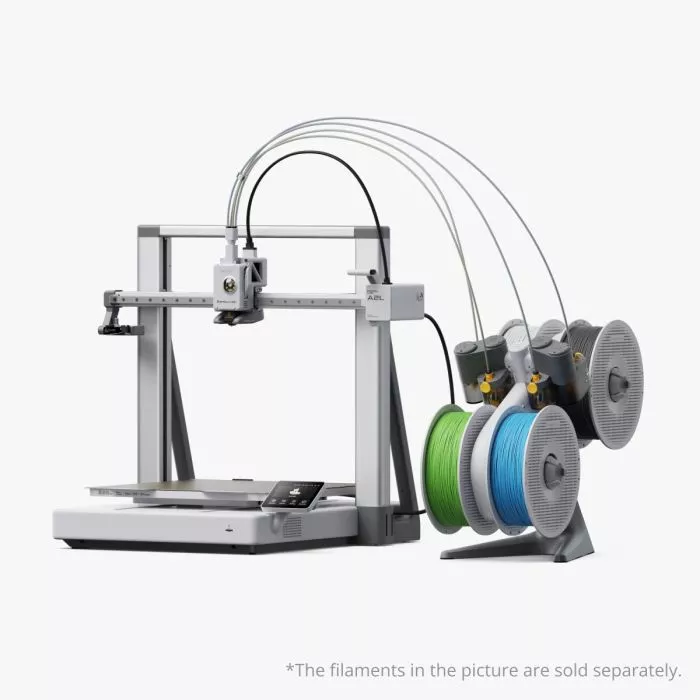
What are the primary differences between the A2L and the A1 series? Is it just a larger version of the A1?
Beyond a 105% increase in build volume (reaching 330mm x 320mm x 325 mm), the A2L features major breakthroughs in core hardware and algorithms:
1. Extrusion System Upgrade: Equipped with a PMSM closed-loop servo extruder, ensuring stable power output during high-speed printing and supporting active monitoring of extrusion anomalies.
2. Adaptive Vibration Compensation: The first model to feature an adaptive algorithm with multi-point calibration & load-adapting, significantly reducing ghosting and ringing on large or tall prints.
3. Physical Resonance Suppression: Two granular dampers are built into the frame to physically absorb resonance, further enhancing surface quality.
4. Multi-functional Creativity: A new modular mounting point allows for the installation of a blade-cutting module for 2D creative projects.
5. More Reliable Nozzle Clumping Detection: A new nozzle clumping detection switch has been added. Dedicated hardware now performs detection through physical contact, making it more stable and reliable.
Why doesn't the A2L feature dual-nozzle or multi-toolhead technology?
The A2L is positioned to provide an ultra-pure, simple, and easy-to-use large-format printing experience. Therefore, we prioritized optimizing core performance—such as build volume, surface quality, and reliability. For users seeking advanced dual-nozzle functionality, our X2D offers an excellent high-value alternative.
How is the noise level during normal printing?
The A2L delivers exceptional silent performance. In Silent Mode, noise levels stay below 49 dB (comparable to a quiet library whisper). In Standard Mode, peak noise is approximately 52 dB. (Data source: Bambu Lab internal testing)
Why is the maximum bed temperature lower than that of A1?
As an open-frame printer, the A2L is primarily designed for non-engineering filaments like PLA and PETG, which have lower bed temperature requirements. Due to the significantly larger surface area, maintaining extreme temperatures would consume excessive power. To prevent overloading home electrical circuits, we set the maximum temperature to 80°C. This strategy perfectly supports mainstream filaments while achieving a more reasonable energy consumption.
What intelligent detection features does the A2L include?
The A2L introduces a PMSM closed-loop servo extruder and a physical "blob" (nozzle clumping) detector, providing more precise extrusion monitoring and reliable protection against filament buildup. Additionally, it inherits the highly acclaimed detection suite from the A1 series, including Filament Run-out, Nozzle Clogging (Air Printing), and Tangled Spool detection.
How many AMS units can be connected to the A2L?
The A2L is highly expandable, supporting up to 4 box-style AMS units and 1 AMS lite connected in series, enabling up to 19-color printing. (Connecting the box-style AMS uses up one buffer path, so one AMS lite slot will be unavailable.)
Does using the AMS drying function on the A2L require an external power supply?
Yes. Due to the power distribution logic of the A2L, the AMS 2 Pro and AMS HT drying functions require a connection to an external independent power source via a power cable or power supply.
Does the A2L support laser or blade-cutting modules?
For safety reasons related to its open-frame design, the A2L does not support laser modules. However, the modular mounting point allows for a blade-cutting module for precision cutting and pen-plotting functions.
What accessories are needed to use the 2D processing features?
You only need to purchase the "Blade Cutting Upgrade Kit," which includes the cutting module, a pen module, a dedicated cutting mat, and related accessories. (You can also get materials for 2D processing in Bambu Store)
Is the blade-cutting functionality on the A2L identical to the H2 series?
The A2L does not have a BirdsEye camera, so it cannot perform the fully automatic Live Spatial Alignment found on the H2 series Laser versions. However, users can use Bambu Handy with their smartphone camera for photo-assisted alignment.