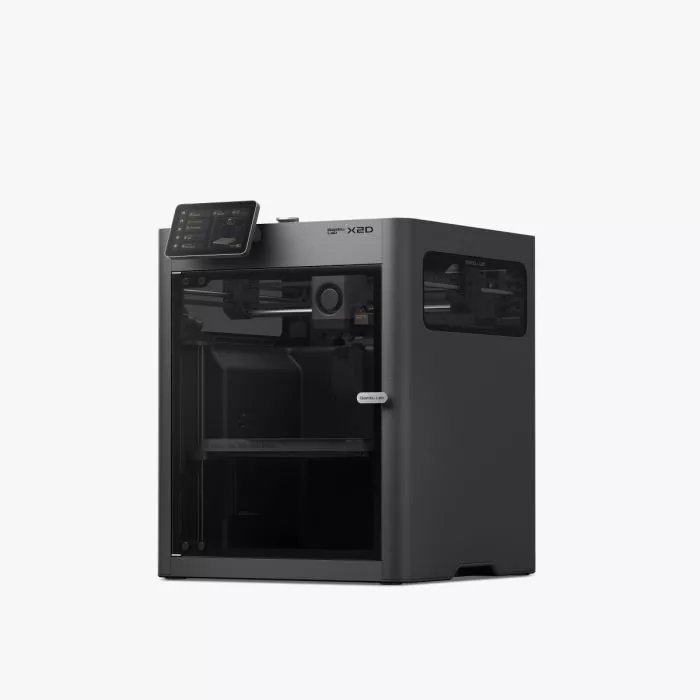
What is the main advantage of the Bambu Lab X2D dual-nozzle system over the X1-Carbon?
The primary advantage is support interface quality and filament waste reduction. On single-nozzle printers like the X1-Carbon, printing support materials requires flushing the entire hotend on every layer change, wasting filament and time. The X2D uses a dedicated second nozzle for support interfaces, resulting in zero-scar support removal, cleaner overhangs, and dramatically faster multi-material prints.
Does the Bambu Lab X2D require an AMS to print multi-color or multi-material?
No, the X2D can print two distinct materials or colors natively using its built-in dual nozzles. However, combining the X2D with the Bambu Lab AMS or AMS 2 Pro unlocks full multi-color capabilities (up to 16+ colors) and automated filament feeding.
Can the X2D print flexible filaments like TPU alongside rigid filaments like PLA or ABS?
Yes. Thanks to its dual-nozzle configuration and refined direct-drive toolhead, the X2D can seamlessly fuse rigid materials (PLA/ABS) and flexible materials (TPU 95A / 85A) in a single print job to build integrated grips, gaskets, and bumpers.
What is the difference between active chamber heating on the X2D and passive heating on the P1S/X1C?
Passive chambers rely solely on heat radiated from the build bed, which is uneven and takes a long time to warm the enclosure. The X2D features a dedicated active chamber heater that forced-circulates hot air up to 65°C, preventing internal stresses and warping on large engineering prints (like ABS, ASA, and Polycarbonate).
What build plates are compatible with the Bambu Lab X2D?
The X2D is compatible with standard 256×256 mm Bambu build plates, including the Textured PEI Plate, Smooth PEI Plate, Cool Plate, and SuperTack Plate. The onboard AI camera scans the plate surface prior to printing to verify proper plate placement and type.
What are the main differences between the X2D and X1C?
The X2D is the X1C's next chapter. It adds a dual-nozzle system for up to 25-color printing, an actively heated chamber (up to 65 °C) for engineering filaments, a servo extruder with real-time flow sensing, filament tangle detection, and expanded AI monitoring.
What is the maximum print speed and acceleration?
When printing with the main nozzle, the X2D reaches a maximum movement speed of 1000 mm/s and a maximum acceleration of 20,000 mm/s².
Are the left and right hotends identical?
Yes, the left and right hotends are identical in structure and components, and can be used interchangeably between left and right positions.
What is the function of the chamber exhaust fan?
It actively extracts air from the chamber. In Cooling Mode, it dissipates heat for PLA. The "Purify Air At Print End" setting clears residual fumes, which can be routed outdoors via a ventilation pipe.
How many AMS units can the X2D connect to?
It supports up to 12 units total (4 AMS 2 Pro and 8 AMS HT units) for 24 slots. Combined with dual hotends, this enables up to 25-color printing.
Does the buffer support connecting two AMS units simultaneously?
No. One port is for the AMS unit and the other is for the chamber exhaust fan. To connect multiple AMS units, daisy-chain them using 6-pin cables.
Can X2D use the standard AMS hub?
No. The X2D is incompatible with the standard AMS hub due to different interface types.
Is the X2D's build plate compatible with X/P/A series printers?
The X2D supports all current Bambu Lab 256×256 mm build plates. It does not automatically recognize 1st-generation plates; if used, you must manually select "Ignore" in the settings.
Does the X2D support high-flow nozzles?
Yes. High-flow hotends can reduce print times by up to 30% compared to standard nozzles while maintaining print quality.
What's the advantage of having two extruders?
The main extruder handles precise flow, while the rear auxiliary extruder overcomes long-distance feeding resistance. This ensures rock-steady delivery for faster color switches and less waste.